

Views: 0 Author: Site Editor Publish Time: 2026-07-21 Origin: Site


Internal material stresses and inconsistent sheet flatness constantly plague modern manufacturing floors. They trigger severe operational bottlenecks and cascade rapidly into downstream mechanical failures. Laser cutting heads crash into warped metal, automated bending angles drift out of tolerance, and robotic welding seams split under the strain of unpredictable material behavior. You simply cannot afford these compounding disruptions.
Legacy manual levelers rely heavily on operator intuition and physical trial-and-error to iron out these defects. Today, modern CNC technology strips away the guesswork completely. It shifts your production floor toward data-driven, mathematically repeatable flattening operations. Upgrading to this technology represents a highly strategic decision for your facility. Evaluating specific architectural features, automation capabilities, and complex integration requirements against your tightest production tolerances is absolutely critical. This guide will walk you through exactly what to look for when upgrading your mechanical assets, ensuring a seamless integration into your existing smart factory ecosystem.
Automation Replaces Guesswork: CNC controls utilize material databases and saved parameter recipes to automatically set roller gaps, reducing setup times and scrap rates.
Dynamic Compensation: Advanced servo-driven systems adjust in real-time under varying load conditions, maintaining strict flatness tolerances across the entire sheet length.
Architectural Rigidity: The physical arrangement of leveling rolls (4-high, 5-high, 6-high) dictates the machine's ability to handle different material yield strengths without deflection.
Implementation Reality: Achieving maximum ROI requires accounting for floor foundation stability, routine roller maintenance, and operator training during the evaluation phase.

Metal sheets naturally harbor massive residual internal stresses. Rolling mills generate these uneven, invisible tensions during the initial coil cooling and winding processes. When you process this stressed metal using thermal cutting methods like laser or plasma, the material rapidly releases its trapped tension. We identify this physical phenomenon as "springback." It warps the parts almost instantly upon cutting. Warped cutouts lead directly to catastrophic laser head collisions, damaged optics, and unacceptably high rejection rates.
A successful equipment implementation changes these metrics entirely. Upgrading should ideally yield a massive, measurable reduction in scrap rates across the board. You want to eliminate dedicated manual rework stations altogether, freeing up valuable floor space and labor. Furthermore, downstream automated systems—like robotic press brakes—should experience significantly increased throughput because they consistently receive perfectly flat, stress-free feed stock.
In the past, facilities relied heavily on skilled operators. These veterans manually adjusted roll pressure through tedious, dangerous trial and error. Modern standardization eliminates this risky dependency. Implementing an automatic sheet leveler ensures strict, repeatable consistency. Every single batch of material receives the exact same mechanical treatment regardless of who runs the afternoon shift. This shift from art to science stabilizes your entire production timeline.
Let us explore the physical makeup of these industrial systems. Multi-tier roll configurations define the core capability of any modern equipment. Engineers design 4-high, 5-high, and 6-high cassette structures specifically to address varying material thicknesses and delicate surface finish needs. We must also address the critical integration of backup rollers. These heavy-duty supports sit directly behind the active work rolls. They prevent microscopic deflection when you process high-yield-strength metals.
Gap adjustment mechanisms have also evolved drastically over the last decade. Traditional hydraulic or mechanical screw-down systems suffer from inherent latency and physical thread wear. In sharp contrast, a modern servo leveling machine provides instantaneous, continuous positioning. It controls the entire leveling frame down to the micron level. This precision guarantees uniform plastic deformation across the entire sheet width, eliminating edge-wave and center-buckle defects.
Structural integrity matters immensely in high-tonnage environments. Frame rigidity and deflection control prevent the machine housing itself from warping under load. Manufacturers utilize heavily ribbed cast iron or heavily fabricated steel frames. The frame must absorb massive high-tensile material forces without experiencing even a millimeter of structural distortion. If the machine frame flexes under load, your precision disappears immediately, rendering the software algorithms useless.
To understand the application of these designs, consider the following structural formats:
4-High Configuration: Features work rolls supported directly by one robust row of backup rolls. It remains the ideal, cost-effective choice for standard industrial mild steels and thicker plates.
5-High Configuration: Adds a dedicated intermediate roll layer on one side. This specific design enhances surface protection for coated or sensitive metals during aggressive flattening.
6-High Configuration: Completely sandwiches the work rolls between intermediate and backup rolls. This represents the ultimate solution for highly sensitive, polished surfaces like aerospace aluminum.
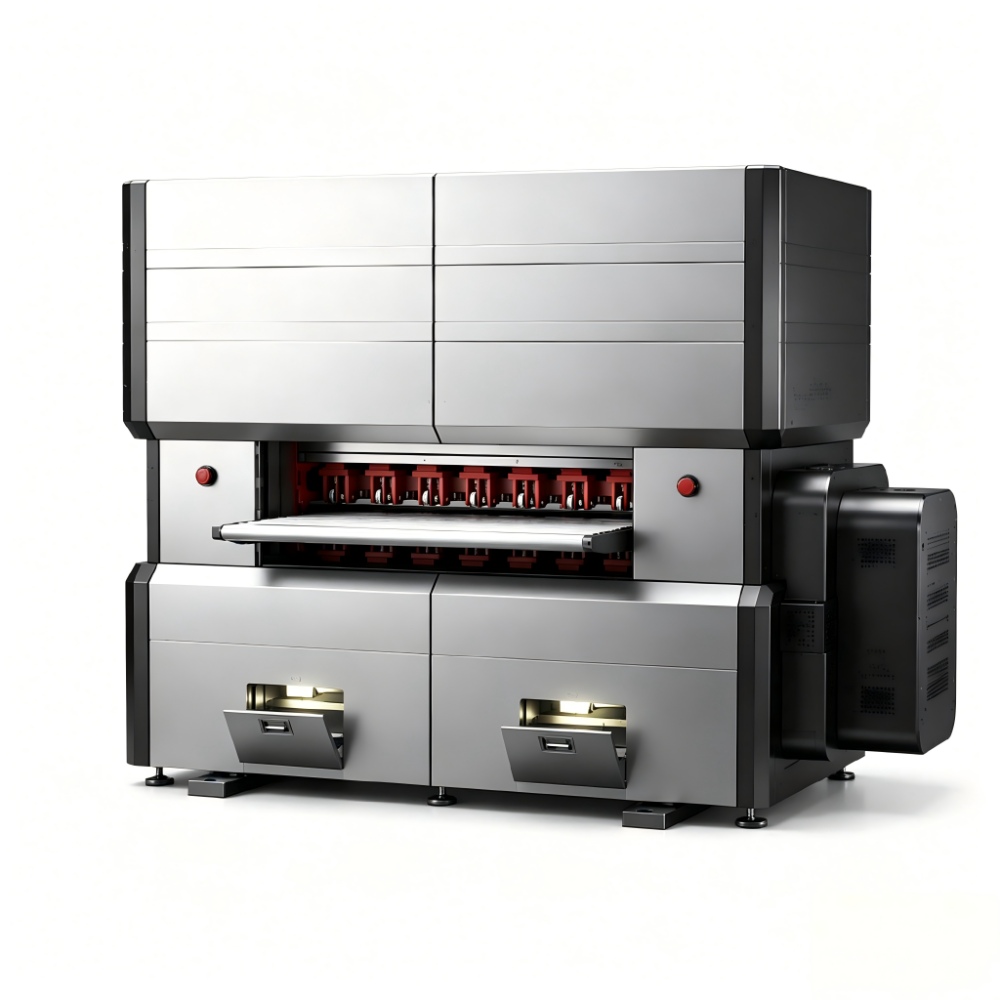
Physical hardware requires deeply intelligent control architectures. Material recipe memory acts as the operational brain of the system. Operators simply input the exact material type, gauge thickness, and specific yield strength into the human-machine interface. The control software immediately searches its extensive internal database. It instantly recalls the optimal tilt, plunge, and gap settings. This digital recall eliminates twenty minutes of manual calibration per batch, drastically improving overall equipment effectiveness.
Closed-loop feedback systems elevate this intelligence even further. Real-time monitoring occurs constantly as metal passes through the flattening zone. Embedded laser or tactile sensors detect minute material thickness variances. The system automatically compensates on the fly, adjusting servo drives in milliseconds. This dynamic, self-correcting adjustment maintains strict output consistency from the leading edge to the trailing edge of every single sheet.
Modern connectivity bridges the traditional gap between the shop floor and executive management. A sophisticated CNC leveling machine connects seamlessly to secure factory networks. You can integrate it directly into your overarching ERP or MES platforms. This high-level connection facilitates accurate production tracking and operational analysis. It also enables remote vendor diagnostics and sends predictive maintenance alerts directly to your reliability engineering team.
Producing predictably flat metal requires rigorous mathematical definitions and standardized benchmarking. Industry flatness measurements usually rely on specific deviations measured in millimeters per meter (mm/m). Upgrading to a dedicated precision leveling machine typically allows you to hit exceptionally tight tolerances, often reaching 0.5 mm/m or better. Complex software algorithms and incredibly rigid roller clusters work in tandem to achieve this impressive output consistency.
Processing vastly different materials demands distinctly engineered approaches. High-tensile steel requires incredibly aggressive plastic deformation. The machine must physically stretch the material's structural fibers beyond their natural yield point to permanently reset the internal memory. Delicate materials present entirely opposite challenges. Aerospace aluminum or brightly polished stainless steel scratches and gall very easily under pressure.
Surface protection features become absolutely mandatory in these high-stakes applications. A premium high precision leveler utilizes highly polished, specially hardened work rolls. It also features perfectly synchronized drive speeds across all roller banks. This precise electronic synchronization prevents even microscopic slippage, which is the primary cause of surface scuffing and cosmetic rejection.
Material Type | Yield Strength Range | Typical Roll Configuration | Expected Flatness (mm/m) |
|---|---|---|---|
Mild Carbon Steel | Up to 350 MPa | 4-High Standard | 1.0 - 1.5 |
High-Tensile Steel | 800 - 1200 MPa | 4-High Heavy Duty | 1.5 - 2.5 |
Copper / Brass Alloys | 150 - 300 MPa | 5-High | 0.8 - 1.2 |
Polished Aluminum | Up to 250 MPa | 6-High | 0.5 - 1.0 |
You cannot simply drop this massive equipment onto a standard industrial concrete floor and expect micron-level accuracy. Facility and foundation prerequisites dictate your ultimate operational success. Physical installation requires serious structural planning. You must install high-grade vibration isolation pads to dampen external floor frequencies. Often, the machine requires a specialized, extra-thick isolated foundation pad to prevent micro-settling. Power draw also spikes dramatically during the aggressive leveling of high-strength steel, so your electrical infrastructure requires thorough verifying.
Maintenance overhead remains a constant variable that requires realistic planning. You should set highly transparent expectations for your entire engineering team. Roller cleaning cycles must happen regularly to prevent mill scale buildup from permanently pitting the delicate work rolls. Bearing lubrication schedules are completely non-negotiable. Many premium machines now feature automated extraction cassette systems. These motorized tracks physically pull the entire internal roller bank out for fast, ergonomic cleaning, minimizing your overall production downtime.
When you begin heavily evaluating vendors, apply strict shortlisting logic to protect your investment. Do not buy a machine rated exactly for your absolute maximum material yield strength. Look closely at their quoted maximum operational thresholds versus realistic daily use. You should ideally size the equipment so your standard daily runs consume only 80% of its total capacity. Pushing the mechanical framework to 100% capacity continually will rapidly accelerate internal wear and heavily jeopardize your long-term flatness accuracy.
Best Practice: Always request an extensive on-site foundation survey from a licensed structural engineer before committing to a heavy-duty model. The cost of a new concrete pad is minor compared to chasing phantom tolerance issues.
Common Mistake: Ignoring routine roller cleaning protocols. Trapped metal particulates will permanently score your expensive work rolls, transferring those defects onto every subsequent sheet you process.
Selecting the right automated flattening equipment requires careful alignment of intelligent software and brute-force mechanical durability. Your entire production floor relies on consistent, flat, stress-free feed stock to feed high-speed downstream automated cells. Any compromise in structural rigidity or software automation inherently undermines your return on investment and threatens product quality.
Your immediate next step is empirical verification. Contact your shortlisted vendors and explicitly demand sample test runs using your own most difficult, high-stress materials. Review their detailed tolerance output reports thoroughly before finalizing any major capital expenditure. Physical proof on your own complex sheet metal remains the only true measure of mechanical capability.
A: Standard straighteners merely remove coil set curvature, leaving most internal stresses intact. CNC levelers perform a much more complex function. They aggressively stretch and compress the material beyond its yield point, neutralizing internal stress completely. The automated software ensures mathematical repeatability across every batch.
A: Yes, but processing perforated material introduces unique challenges. It requires specific software capabilities to avoid over-bending sections containing less physical material volume. You should look for machines featuring localized pressure control or independent backup roll adjustments to handle varied resistance safely.
A: The highest wear components are the work rolls, backup bearings, and drive universal joints. Constant extreme pressure degrades these elements over time. To reduce maintenance downtime, emphasize purchasing equipment with quick-change roller cassettes, allowing operators to swap worn parts in minutes rather than hours.

